Hi there! Google CTF 2024 had three reverse challenges I looked at, but only not_obfuscate is written up here so far. X86PERM and IEEE will follow. The interesting part is that I did not solve this one during the contest: the author never wrote an obfuscator at all, Clang did that work for him, and what stopped me was not the assembly but the arithmetic sitting underneath it. Reverse engineering keeps turning into a maths problem, and this challenge made that obvious to me.
Reverse §
not_obfuscate §
Description:
True story: I had planned on learning to write LLVM passes and use them for obfuscation for this year’s gCTF challenge.However, when I compiled this code with optimizations enabled, I decided I didn’t need to write an obfuscator.
It’s a crackme, you know the drill. GL HF!
analysis §
After a quick check, I found the code flow is effortless:
First, it reads 32 chars from the console, then converts it from hex bytes. It saves these bytes as a rc4 key.11 RC4 is a stream cipher: it makes a key stream from the key and XORs it with the data. So we know that it takes the 16-byte key from our input.
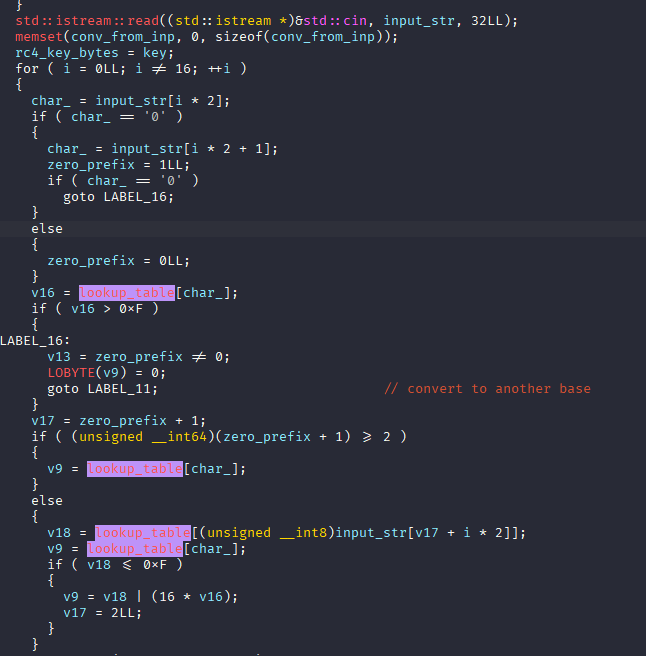
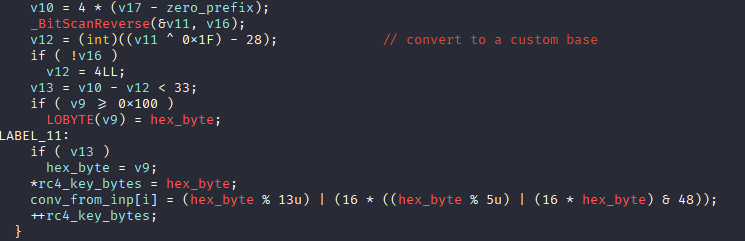
That key is just used for rc4 to decrypt a given buffer, a.k.a flag.
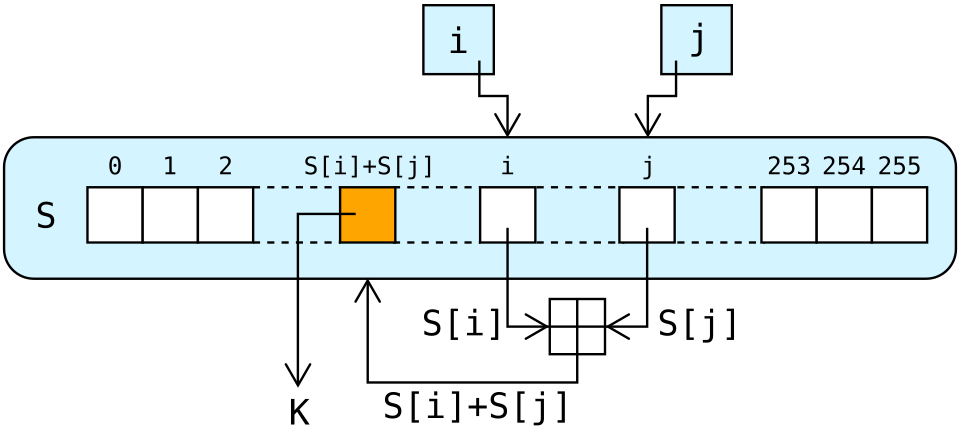 Reference: RC4 on Wikipedia
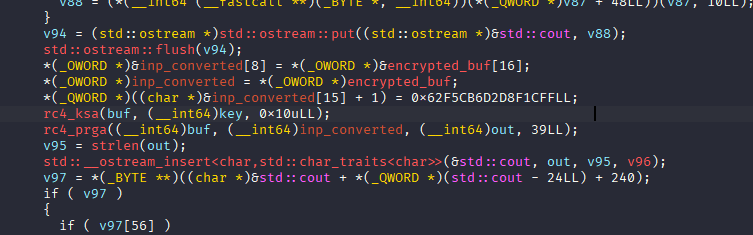
After that, it converts 16 bytes to an array, also a 4x4 matrix22 16 numbers read row by row: items 0-3 are row 1, items 4-7 are row 2, and so on. (the matrix is that thing I don’t think about when doing the challenge, so I got stuck while analyzing and guessing that thing).
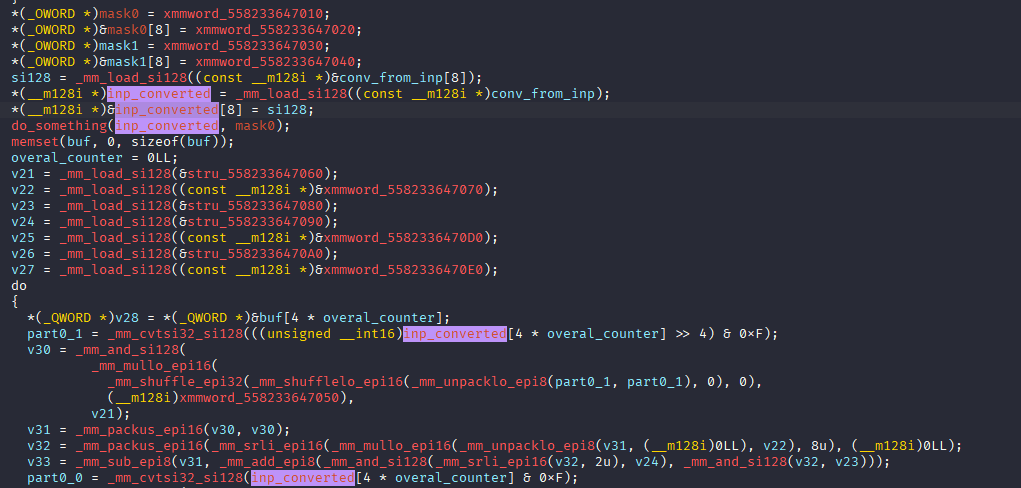
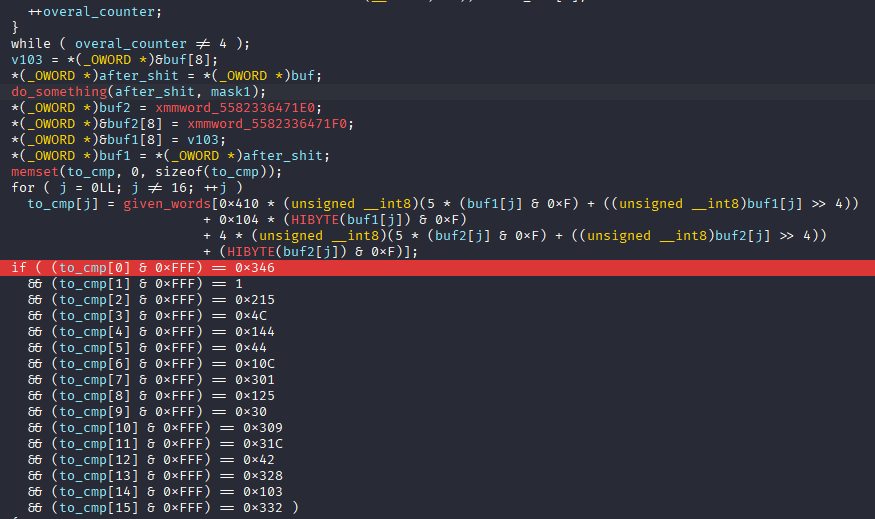
So, here is the code flow of the challenge:
matrix_input = convert_fromhex()

matrix_temp = func(matrix_input,given_matrix_1)

...// a whole bunch of code with `matrix_temp`...

result = func(matrix_temp,given_matrix_2)

result = substitute(result) // like a AES subbyte

-> compare `result` with the given result [0x345,0x1,0x215...]
To be honest, I didn’t solve the challenge but after a quick check of the src, I can’t believe that the challenge flow is not hard at all, it’s about the math problem. So I decided to test it all.
Okay, just think, if we know that a 16-word array is a matrix, so do_something is probably an operation of the matrix, like add, multiply, inverse,…vv.
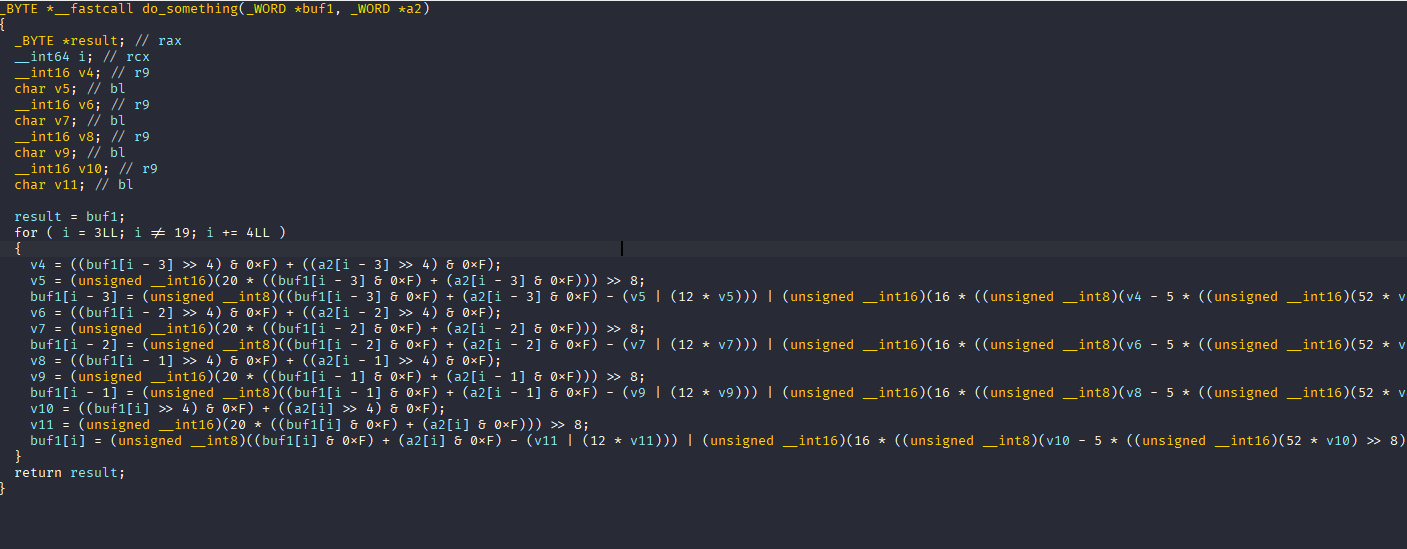
So I decided to test it, this one is the input matrix.
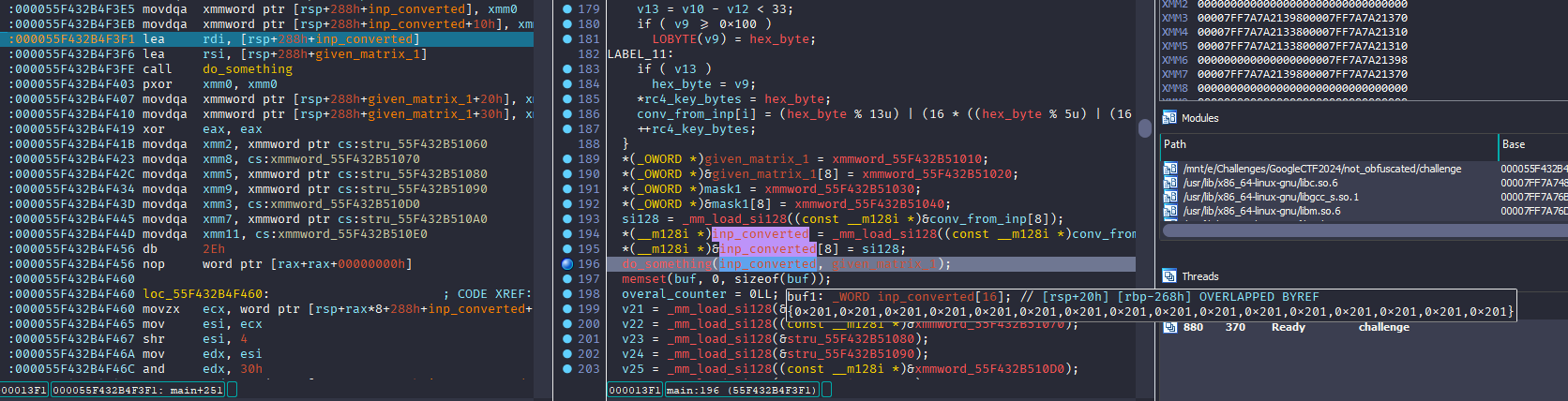
import numpy as np

def array_to_matrix(a:list):
    return np.matrix([a[0:4],a[4:8],a[8:12],a[12:16]])

inp = [0x201, 0x201, 0x201, 0x201, 0x201, 0x201, 0x201, 0x201, 0x201, 0x201, 0x201, 0x201, 0x201, 0x201, 0x201, 0x201]
inp_matrix = array_to_matrix(inp)
buf1 = [0x49, 0x324, 0x7, 0x22, 0x24b, 0x210, 0x123, 0x17, 0x2b, 0x329, 0x21, 0x3, 0x241, 0x344, 0x330, 0x32a]
given_matrix_1 = array_to_matrix(buf1)

##test
result = inp_matrix+given_matrix_1
result = np.remainder(result,0x400)
print(result)
result = inp_matrix*given_matrix_1
result = np.remainder(result,0x400)
print(result)
Here’s result in python:
[[586 293 520 547]
 [ 76  17 804 536]
 [556 298 546 516]
 [ 66 325 305 299]]

[[256 417 635 870]
 [256 417 635 870]
 [256 417 635 870]
 [256 417 635 870]]
result in IDA:
[586, 293, 520, 547, 76, 17, 804, 536, 556, 298, 546, 516, 66, 325, 305, 299]
So, do_something seems like a matrix add operation. But when I take another add, it seems incorrect:
tmp1 = array_to_matrix([0x248, 0x10a, 0x323, 0x230, 0x125, 0x149, 0x206, 0x132, 0x217, 0x10b, 0x312, 0x220, 0x1a, 0x228, 0x46, 0x307])
tmp2 = array_to_matrix([0x308, 0x227, 0x133, 0x1, 0x120, 0x139, 0x205, 0x100, 0x145, 0x221, 0x29, 0x11a, 0x318, 0x13, 0x11a, 0x16])

print(np.remainder(tmp1,tmp2))
Result:
[[584 266 189   0]
 [  5  16   1  50]
 [210 267   7 262]
 [ 26   1  70   5]]
Result in IDA:
[323, 804, 6, 561, 581, 549, 11, 562, 780, 812, 827, 826, 805, 571, 259, 784]
Even add operation in a special way, I will explain in rns:
So the correct add is:
def add(a,b):
    ret = 0
    ret = ((a>>8) + (b>>8))%4
    ret <<= 4
    ret |= (((a>>4)&0xf)+((b>>4)&0xf))%5
    ret <<= 4
    ret |= ((a&0xf) + (b&0xf))%13
    return ret

print([add(x,y) for x,y in zip(tmp1,tmp2)]) # [323, 804, 6, 561, 581, 549, 11, 562, 780, 812, 827, 826, 805, 571, 259, 784]
Then we know:
add(inp,matrix1)

...whole bunch of code...

add(inp,matrix2)
I found another matrix that I didn’t know while doing this challenge (it looked like an unknown xmmword, so I formatted and renamed it):


Do you think a whole bunch of code means just a simple operation? Yes, that’s it, the matrix multiplied with the other given matrix I found.
Testing
temp_matrix = inp_matrix+given_matrix_1
temp_matrix = np.remainder(temp_matrix,0x400)
after_shit = np.remainder(temp_matrix*another_matrix,0x400)
print(after_shit)
[[ 833  772  481   37]
 [ 162  395  832 1005]
 [ 708  856  200   72]
 [ 651  559  943  164]]
Result in IDA:
Python>result = [idaapi.get_word(0x7FFDDB69FAA0 + i) for i in range(0,32,2)]
Python>print(result)
[584, 266, 803, 560, 293, 329, 518, 306, 535, 267, 786, 544, 26, 552, 70, 775]
It’s not working, am I missing something?
After a quick check, I found that another_matrix is used for later, and I see that just a simple xor operation but in the form of substitution.
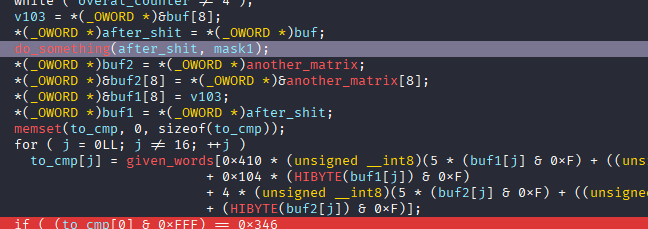
def rns_xor_with_buf2(buf):
    ret = [0]*16
    for i in range(16):
        num = buf[i] # decode before xor
        a,b,c = num&0xf,(num>>4)&0xf,(num>>8)&0xf
        d,e,f = buf2[i]&0xf,(buf2[i]>>4)&0xf,(buf2[i]>>8)&0xf
        idx = 0x410 * ((5 * a + b)&0xff) + 0x104 * c + 4 * ((5 * d + e)&0xff) + f
        ret[i] = given_words[idx]
    return ret
I know it’s xor after checking the src code before it xor before it’s pack and decode the matrix. (matrix using a custom base in range 260, instead of 256)
Keep in mind this, the matrix uses rns, which is like another base.
rns §
Reference: residue number system, and these lecture notes if you want the arithmetic worked through.Residue number system
A residue numeral system (RNS) is a numeral system representing integers by their values modulo several pairwise coprime integers called the moduli. This representation is allowed by the Chinese remainder theorem, which asserts that, if M is the product of the moduli, there is, in an interval of length M, exactly one integer having any given set of modular values. The arithmetic of a residue numeral system is also called multi-modular arithmetic.
conv_from_inp[i] = (hex_byte % 13u) | (16 * ((hex_byte % 5u) | (16 * hex_byte) & 0x30));
which means:
input_in_hex = [0x61,0x61,0x61,0x61,...] #'aaaaaaaaa'

matrix = rns(input_in_hex) #[rns(0x61),rns(0x61),rns(0x61),...]
#encode -> [0x12,0x12,......], in base 260

# and the `given_words` also known as `xor_table`
xor_table = [rns(byte_a^ byte_b
                 not
xor_table = [rns(byte_a) ^ rns(byte_b)]
That’s the reason why I got stuck for a long time…
So, we know the property of xor, then just xor again and we get the original buffer.
to_cmp = after_shit ^ another_matrix

=> after_shit = to_cmp ^ another_matrix
Just get the xor_table from binary, and then I use this function to operate xor.
I’ve tried this one but it didn’t work when I do it again, even if I patch these words into IDA and let it run, still got the wrong answer.
buf2 = [0x1a, 0x12c, 0x24c, 0x11c, 0x12a, 0x137, 0x210, 0x111, 0x242, 0x31b, 0x126, 0x327, 0x329, 0x20b, 0x3, 0x220]
# `another_buffer` a.k.a `buf2`

def rns_xor_with_buf2(buf):
    ret = [0]*16
    for i in range(16):
        num = buf[i]
        a,b,c = num&0xf,(num>>4)&0xf,(num>>8)&0xf
        d,e,f = buf2[i]&0xf,(buf2[i]>>4)&0xf,(buf2[i]>>8)&0xf
        idx = 0x410 * ((5 * a + b)&0xff) + 0x104 * c + 4 * ((5 * d + e)&0xff) + f
        ret[i] = given_words[idx]
    return ret
So I write another function to xor but just using brute foce, and it work:
def another_xor(buf):
    res = []
    for i in range(16):
        res.append(brute(buf2[i],buf[i]))
    return res
def brute(b2,to_cmp):

    for hex_byte in range(256):
        num = 0
        num += hex_byte % 4
        num <<= 4
        num += hex_byte % 5
        num <<= 4
        num += hex_byte % 13

        a,b,c = num&0xf,(num>>4)&0xf,(num>>8)&0xf
        d,e,f = b2&0xf,(b2>>4)&0xf,(b2>>8)&0xf
        idx = 0x410 * ((5 * a + b)&0xff) + 0x104 * c + 4 * ((5 * d + e)&0xff) + f
        if given_words[idx] == to_cmp:
            # print(hex(num),num)
            return num

    return None
def main():

    #recover
    recovered = another_xor(to_cmp_w)
    print(recovered)

    #test
    tmp = rns_xor_with_buf2(recovered) # also check in IDA
    print(tmp==to_cmp_w)
[771, 282, 38, 267, 39, 299, 819, 576, 770, 843, 529, 32, 837, 323, 315, 257]
True
Now, we have completed step 1, and here’s the flow we got:
tmp = (inp + matrix_1)

sus(tmp) #Whole bunch of Code

tmp = add(tmp,matrix_2)
tmp = xor(tmp, another_matrix)

if tmp == buf:
    #we got it
and we have: matrix_1, matrix_2, another_matrix, and buf
Whole bunch of Code? §
The feeling…
RULE 35: It just a matrix operation
Before we reverse, I figure out how it is possible. I mean, How can a simple operation be a bunch of code?
Here’s a simple matrix multiply from programiz but I’m using built-in type: long double instead of int:
#include <iostream>
using namespace std;

int main()
{
    long double a[10][10], b[10][10], mult[10][10];
    int r1, c1, r2, c2, i, j, k;

    cout << "Enter rows and columns for first matrix: ";
    cin >> r1 >> c1;
    cout << "Enter rows and columns for second matrix: ";
    cin >> r2 >> c2;
    while (c1!=r2)
    {
        cout << "Error! column of first matrix not equal to row of second.";

        cout << "Enter rows and columns for first matrix: ";
        cin >> r1 >> c1;

        cout << "Enter rows and columns for second matrix: ";
        cin >> r2 >> c2;
    }

    // Storing elements of first matrix.
    cout << endl << "Enter elements of matrix 1:" << endl;
    for(i = 0; i < r1; ++i)
        for(j = 0; j < c1; ++j)
        {
            cout << "Enter element a" << i + 1 << j + 1 << " : ";
            cin >> a[i][j];
        }

    // Storing elements of second matrix.
    cout << endl << "Enter elements of matrix 2:" << endl;
    for(i = 0; i < r2; ++i)
        for(j = 0; j < c2; ++j)
        {
            cout << "Enter element b" << i + 1 << j + 1 << " : ";
            cin >> b[i][j];
        }

    // Initializing elements of matrix mult to 0.
    for(i = 0; i < r1; ++i)
        for(j = 0; j < c2; ++j)
        {
            mult[i][j]=0;
        }

    // Multiplying matrix a and b and storing in array mult.
    for(i = 0; i < r1; ++i)
        for(j = 0; j < c2; ++j)
            for(k = 0; k < c1; ++k)
            {
                mult[i][j] += a[i][k] * b[k][j];
            }

    // Displaying the multiplication of two matrix.
    cout << endl << "Output Matrix: " << endl;
    for(i = 0; i < r1; ++i)
        for(j = 0; j < c2; ++j)
        {
            cout << " " << mult[i][j];
            if(j == c2-1)
                cout << endl;
        }

    return 0;
}
So, I compiled with Clang++ and see the different between without optimize and optimize flag enabled:
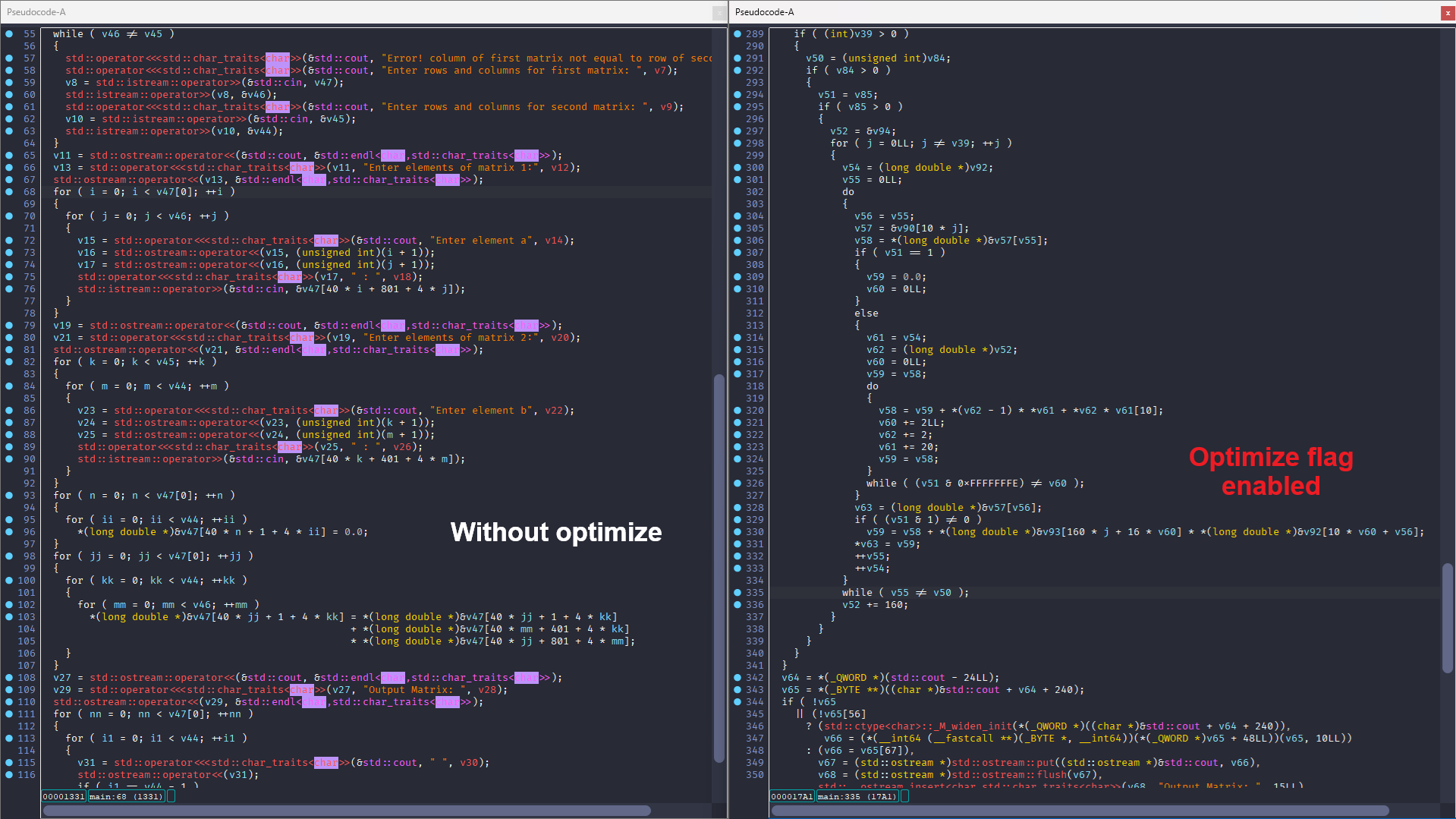
We easily see that optimization makes the code harder. Even if it is just a built-in type, the challenge is using a custom one, which is almost impossible.
It’s just a point of view from a reverser.More on what the optimizer does: Clang optimization flags, a Hacker News thread and this r/C_Programming thread on how far it will go.
In the challenge, we see it as SIMD.33 SIMD means one instruction operating on several values at once. The compiler rewrote the three nested loops of a matrix multiply into a handful of wide register operations, which is why the result looks nothing like the source.Reference: the basics of SIMD programming and using SIMD to optimize x86 assembly.
We know that the code just doing some simple operations but is optimized.
After a day I figure out what is it. I finally found it just matrix multiply (as I guess) but it was difficult to find the multiplicand (matrix A)
So, to save time I decided to get it from src code (will be updated later).
Here is the complete flow:
A = Matrix_rns([208, 120, 107, 19, 138, 163, 11, 174, 217, 67, 60, 143, 13, 232, 181, 2],conv=True) # from source
B = Matrix_rns([0x49, 0x324, 0x7, 0x22, 0x24b, 0x210, 0x123, 0x17, 0x2b, 0x329, 0x21, 0x3, 0x241, 0x344, 0x330, 0x32a],ls=True) #from IDA
C = Matrix_rns([0x308, 0x227, 0x133, 0x1, 0x120, 0x139, 0x205, 0x100, 0x145, 0x221, 0x29, 0x11a, 0x318, 0x13, 0x11a, 0x16],ls=True)#from IDA
D = Matrix_rns([0x1a, 0x12c, 0x24c, 0x11c, 0x12a, 0x137, 0x210, 0x111, 0x242, 0x31b, 0x126, 0x327, 0x329, 0x20b, 0x3, 0x220],ls=True)#from IDA

#### THE FLOW
inp_matrix = Matrix_rns([0x201, 0x201, 0x201, 0x201, 0x201, 0x201, 0x201, 0x201, 0x201, 0x201, 0x201, 0x201, 0x201, 0x201, 0x201, 0x201],ls=True) # test input with 'aaaaaaaaaaaaaaaaaaaa'

temp = inp_matrix.add(B)
# print(temp.as_list())
temp = temp.mul(A)
# print(temp.as_list())
temp = temp.add(C)
# print(temp.as_list())
result = temp.xor(D)
And here’s the way that I operate xor to get the previous buffer before compare (expected_to_cmp):
from given_words import given_words,L

buf2 = [0x1a, 0x12c, 0x24c, 0x11c, 0x12a, 0x137, 0x210, 0x111, 0x242, 0x31b, 0x126, 0x327, 0x329, 0x20b, 0x3, 0x220]
buf1 = [0 for _ in range(16)]
aftershit = [0x143, 0x324, 0x6, 0x231, 0x245, 0x225, 0xb, 0x232, 0x30c, 0x32c, 0x33b, 0x33a, 0x325, 0x23b, 0x103, 0x310]
to_cmp_w = [0x346,1,0x215,0x4C,0x144,0x44,0x10C,0x301,0x125,0x30,0x309,0x31C,0x42,0x328,0x103,0x332]
assert len(to_cmp_w)==16

def get_index(value):
    #rebuild from src
    m = [13,5,4]
    res = [0]*3
    index = 0
    for i in range(3):
        res[2 - i] = (value >> (4 * i)) & 0xF
    for i in range(3):
        index += res[2-i]
        if i+1 < 3:
            index *= m[1-i]
    # index &= 0xff
    return index

def rns_xor_with_buf2(buf):
    ret = [0]*16
    for i in range(16):
        num = buf[i]
        a,b,c = num&0xf,(num>>4)&0xf,(num>>8)&0xf
        d,e,f = buf2[i]&0xf,(buf2[i]>>4)&0xf,(buf2[i]>>8)&0xf
        idx = 0x410 * ((5 * a + b)&0xff) + 0x104 * c + 4 * ((5 * d + e)&0xff) + f
        ret[i] = given_words[idx]
    return ret
def another_xor(buf):
    res = []
    for i in range(16):
        res.append(brute(buf2[i],buf[i]))
    return res
def brute(b2,to_cmp):
    nums = []
    for hex_byte in range(256):
        num = 0
        num += hex_byte % 4
        num <<= 4
        num += hex_byte % 5
        num <<= 4
        num += hex_byte % 13
        a,b,c = num&0xf,(num>>4)&0xf,(num>>8)&0xf
        d,e,f = b2&0xf,(b2>>4)&0xf,(b2>>8)&0xf
        idx = 0x410 * ((5 * a + b)&0xff) + 0x104 * c + 4 * ((5 * d + e)&0xff) + f
        if given_words[idx] == to_cmp:
            # print(hex(num),num)
            nums.append(num)
    print(nums)
    return nums[-1]

def main():
    brute(buf2[4],324)

    #recover
    recovered = another_xor(to_cmp_w)
    print(recovered)

    #test
    tmp = rns_xor_with_buf2(to_cmp_w)
    print(tmp)

if __name__=='__main__':
    main()
I tried both ways: brute and get xor table, which got me 2 different matrices.
[771, 282, 38, 267, 39, 299, 819, 576, 770, 843, 529, 32, 837, 323, 315, 257]
[771, 282, 38, 267, 76, 299, 819, 576, 770, 843, 529, 32, 837, 323, 315, 257]
I’ve reimplement the rns matrix in python, just need the matrix invert operation.
Here invert from @d4rk9n1ght in sagemath.
def convert_to_1mod(arr):
    result = []
    for i in arr:
        a,b,c = i&0xf, (i>>4)&0xf, (i>>8)&0xf
        res = crt([c,b,a], [4,5,13])
        result.append(res)
    return result
def convert_to_3mod(arr):
    result = []
    cp = [int(i) for i in arr]
    for i in cp:
        a,b,c = i %4, i%5, i%13
        hehe = a
        hehe <<= 4
        hehe |= b
        hehe <<= 4
        hehe |= c
        result.append(hehe)
    return result

from sage.all import *

gl = GL(3, Zmod(4*5*13))

arr = [48, 3, 803, 838 ,568, 823, 795, 581 ,297, 802, 8, 816, 304, 43, 284, 546]
arr = convert_to_1mod(arr)
A = [arr[:4], arr[4:8], arr[8:12], arr[12:]]

A = Matrix(Zmod(4 * 5 * 13), A)
print(A.is_invertible())
inv_A = A.inverse()

print(A * inv_A)
# print(inv_A)
inv_A_arr = list(inv_A[0]) + list(inv_A[1]) + list(inv_A[2]) + list(inv_A[3])
# print(inv_A_arr)
final = convert_to_3mod(inv_A_arr)
print(final)
output
[811, 276, 795, 9, 295, 561, 306, 825, 295, 309, 842, 844, 580, 842, 279, 313]
Here’s script that recover the input:
A_inv = Matrix_rns([811, 276, 795, 9, 295, 561, 306, 825, 295, 309, 842, 844, 580, 842, 279, 313],ls = True)
print(A.mul(A_inv))
# aftershit = Matrix_rns([0x248, 0x10a, 0x323, 0x230, 0x125, 0x149, 0x206, 0x132, 0x217, 0x10b, 0x312, 0x220, 0x1a, 0x228, 0x46, 0x307],ls=True)

x = aftershit.mul(A_inv)
x = x.sub(B)
x = [x.decode(i) for i in x.as_list()]
print(bytes(x).hex())
output
[[273, 0, 0, 0], [0, 273, 0, 0], [0, 0, 273, 0], [0, 0, 0, 273]]
fcedd5ab42f188b49760fca0d51e6fb1
So, I finally found the correct input but still the wrong key for decryption. It is probably the problem from 2 matrices that I found above.
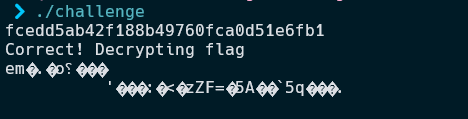
Also, I tried to brute force the byte in the matrix and got the result:
A_inv = Inverse(Matrix_rns([208, 120, 107, 19, 138, 163, 11, 174, 217, 67, 60, 143, 13, 232, 181, 2],conv=True).as_list())
A_inv = Matrix_rns(A_inv,ls = True)
print("A_inv: ",A_inv.matrix) ### A_inv is correct
enc_flag = b'\xe8M0a\x19\t\x8e\xac\x99\x8a\x8e:\x0f\xf1\xf6%w9t-h#\xc7{~\xa4\xcb\xbe\xee\xc7E\xff\x1c\x8f-m\xcb\xf5b'
for hex_byte in range(256):
    num = 0
    num += hex_byte % 4
    num <<= 4
    num += hex_byte % 5
    num <<= 4
    num += hex_byte % 13
    aftershit.matrix[3][1] = num ## the wrong number is at matrix[3][1], I've test by each number of matrix.
    x = aftershit.mul(A_inv)
    x = x.sub(B)
    x = [x.decode(i) for i in x.as_list()]

    try:
        #print(bytes(x).hex())
        arc = ARC4(bytes(x))
        flag = arc.decrypt(enc_flag)
        if b'CTF' in flag or b'ctf' in flag:
            print(flag)
    except:
        #print(x)
        pass
output
A: [[48, 3, 803, 838], [568, 823, 795, 581], [297, 802, 8, 816], [304, 43, 284, 546]]
B: [[73, 804, 7, 34], [587, 528, 291, 23], [43, 809, 33, 3], [577, 836, 816, 810]]
C: [[776, 551, 307, 1], [288, 313, 517, 256], [325, 545, 41, 282], [792, 19, 282, 22]]
D: [[26, 300, 588, 284], [298, 311, 528, 273], [578, 795, 294, 807], [809, 523, 3, 544]]
A_inv: [[811, 276, 795, 9], [295, 561, 306, 825], [295, 309, 842, 844], [580, 842, 279, 313]]
b'Flag: ctf{I_pr0mize_its_jUsT_mAtriCeS}\x00'
Finally got flag: ctf{I_pr0mize_its_jUsT_mAtriCeS}
In my point, it’s the easiest challenge, and not interested at all, but at least, I know that I need to learn more, more, and more math. The new meta of Reverse. Also, I will update the remaining challenge later, pls enjoy.